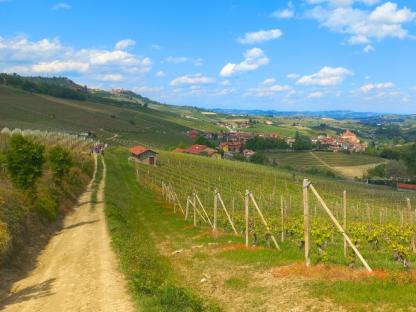
the vineyard hills  of barolo valley

Langhe: in Piedmont, Barbera to Barolo

LEVEL
2
DISTANCE
85 km
DURATION
8 days | 7 nights
PERIOD
Apr May Jun Jul Aug Sep Oct Nov
PRICE FROM
€ 831
CO2e FOOTPRINT
117 Kg/person
  1. Italy
  2.  | 
  3. Self-Guided
  4.  | 
  5. Tourcode ITSW030

Piemonte is Italy’s paradise for true connoisseurs of mouth-watering food, truffles and fabulous wines. Set between the Alps and the Apennine mountains, the Langhe region offers fertile lands that produce the prized Tuber Magnatum – the renowned white truffle – and some of Italy’s most prestigious red wines, including Barolo and Barbera. Here you can discover an impressive variety of local specialties such as gourmet cheeses, pastries and chocolates appreciated all over the world.

This walking trip follows the scenic Barbera Barolo Walking Trail, guiding you across a magnificent landscape of rolling hills dotted with small picturesque villages, elegant castles and ancient towers. You will walk through vineyards and hazelnut forests, staying in charming rural villages where warm hospitality and excellent local cuisine complete the experience.

Highlights

  • Try the endless selection of incredible wines, cheeses, truffle, sweets and chocolates to taste along the way
  • Walk through the vineyard and the groomed hazelnut forests
  • Enjoy the spectacular views of the snow capped Alps on clear days
  • Immerse yourself in the peace of the foot paths

Itinerary

Day 1

Arrive in Alba

Arrive in Alba

Arrive in Alba, the heart of Piedmont wine country, a captivating medieval city of a “hundred towers” and a treasure chest of flavours and aromas. After checking in, go out for a walk to explore the town and why not stop in one of its many divine pastry shops to tempt your palate. Treat yourself to the sweet tastes of Italy. 

Day 2

From Roddi to Barolo or Vergne, 18 km o 15 km

From Roddi to Barolo or Vergne, 18 km o 15 km

A transfer takes you to Roddi or Verduno (to shorten the walk). Crossing several hills you reach the rustic village of La Morra from where you continue to the hamlet of Vergne and on route you have several wine tasting options. On clear days you can see the Alps and Mt. Monviso that stay snow capped till the beginning of summer. 

Distance: 18 o 15 km

Elevation gain: +522 -426 m

Day 3

From Barolo to Monforte d’Alba, 11 km

From Barolo to Monforte d’Alba, 11 km

Passing by the old village of Novello, with its Middle Age tower you reach the wine capital of Barolo, where this famous wine is produced. You can visit the museum in the Castello dei Marchesi Falettiand the Regional wine museum, a must for any wine connoisseur. After a varying walk through the vineyards and forests, you arrive in Monforte d'Alba, a nice hill top village.

Distance: 11 km

Elevation gain: +440/ -415 m

Day 4

From Monforte d'Alba to Cissone, 15 km

From Monforte d'Alba to Cissone, 15 km

The landscape is far more varied than on the previous days as you leave the vineyards behind and climb through tidy hazelnut forests and wild woods surrounding the ancient hamlet of Serralunga d’Alba. From here a steep climb brings you to Roddino from where a long descent takes you to the final climb up to Cissone

Distance: 15 km

Elevation gain: +806/ -665 m

Day 5

Cissone round walk, 8 km

Cissone round walk, 8 km

A glass of local wine from a traditional "cantina" in the centre of the village is a lovely way to celebrate this day of relaxing and taking it easy. After a short circular walk in the neighborhood of Cissone, unwind and admire the splendid views from the farm. The scenery is a unique spectacle, embroidered with vineyards and dotted with towers and castles.

Distance: 8 km

Elevation gain: +300/-300 m

Day 6

From Cissone to Cravanzana, 17,5 km

From Cissone to Cravanzana, 17,5 km

The landscape of the high Langhe area around Cissone is characterised by hazelnut forests and those slopes that are too steep to be cultivated are covered by oaks. This is also the area where you find the most precious of the local treasure: the ‘Tuber Magnatum’, also known as ‘the white truffle of Alba’ and, if you don’t find it underground, you are sure to find it at the local restaurant.

Distance: 17,5 km

Elevation gain: +650/-870 m

Day 7

From Cravanzana to Cortemilia, 12 km

From Cravanzana to Cortemilia, 12 km

Today the landscape is as varied as the walk itself. You visit the villages of Torre Bormida and Bergolo that you reach crossing hazelnut plantations and dense chestnut woods using broad forest paths, small grassy trails and narrow cobbled streets until you reach the town of Cortemilia. On clear days the view on the hills and the Alps is breath-taking.

Distance: 12 km

Elevation gain: +485/-755 m

Day 8

Arrivederci Cortemilia!

Arrivederci Cortemilia!

Our services end after breakfast unless you have booked another service with us.

Details

Included


What is included

  • 7 Nights in double room in **/*** hotels , B&B and agriturismi with breakfast
  • luggage transportation from hotel to hotel
  • transfers as described in the day by day itinerary
  • maps and detailed description of the itinerary in digital form, app
  • Medical and luggage travel insurance
  • 24h phone assistance

What is not included 

  • Transfers to the starting location and from the arriving location of the tour
  • lunches and dinners, if not otherwise stated
  • visits and entrance fees - tips
  • personal expense
  • possible sojourn taxes
  • everything that is not mentioned in the "What is included" section.

Optional Services

These services can be added to the ones included in the base price of the tour:

  • Single room supplement
  • cancellation insurance
  • Transfers to reach the starting location or to leave the arriving location of the tour, which will be quoted on request.
  • travel documentation in printed form (maps and detailed description of the itinerary), shipped to the first hotel

NOTE

From half September until the end of November, there is a supplement of 40 euros per room per night in Hotel Calissano in Alba for all the bookings that fall on Friday and Saturday.

Classic Hotels


Accommodation on Our Trips

Our adventures feature a variety of accommodations, depending on the location and the type of trip you choose. We carefully select each property, ensuring it is well situated along the route and locally run, so that you receive a warm welcome and enjoy a comfortable, authentic experience.

Your comfort is a priority throughout your travels. Most of our trips include stays in friendly, independent, or family-run hotels, guest houses, and B&Bs. Each accommodation is chosen for its charm, cleanliness, and those personal touches that make you feel at home. Some trips offer more elevated stays that feel like a special treat, while others may include simpler options, such as mountain refuges, particularly in remote areas.

Classic Hotels – Comfort with Character

Most of our trips combine a variety of accommodation styles to suit the route and location. You will typically stay in charming, locally owned B&Bs, guest houses, inns, and small hotels that offer a warm welcome and comfortable surroundings. These properties often feature extra touches such as distinctive regional character, leisure facilities, or renowned local cuisine.

All accommodations feature private ensuite bathrooms unless otherwise specifically noted for mountain huts, refuges, and pilgrim hostels.

On some mountain adventures and selected pilgrimage routes, the experience may also include more basic accommodation, such as mountain huts, refuges, or pilgrim hostels, where ensuite rooms are not always available and shared bathrooms or dormitory-style accommodation may be part of the experience.
While simpler in style, these accommodations are often rich in atmosphere and camaraderie, providing an authentic connection with fellow travellers and the places you visit.

Hotel Savona Alba
Hotel Calissano - Alba

The Calissano Hotel is located near the central Piazza M. Ferrero, one of the most beautiful squares in Piedmont, known as “the drawing-room of Alba” because it is a meeting place for people from the town and surrounds.
Each year thousands of tourists are attracted to this town of Roman and medieval origins by its great Wines and excellent cuisine, and the heady aroma of the White Truffle of Alba.


Agriturismo Ca' San Ponzio Barolo
Agriturismo Ca' San Ponzio - Barolo

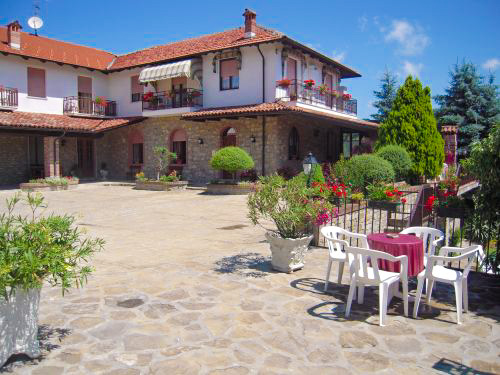
Agriturismo Ca' San Ponzio is a restored farmhouse, surrounded by serenity, peace and nature. Rustic rooms are very comfortable, spacious and well-finished. Every room has a balcony with view on a beautiful landscape on Langhe's hills. Owners are courteous and helpful. Breakfast is very good with home-made products. 


Hotel Grappolo d'Oro Monforte d'Alba
Hotel Grappolo d'Oro - Monforte d'Alba

Il Grappolo D'Oro is located in Piazza Umberto I, the main square in Monforte D'Alba. Rooms and apartments have a traditional design with tiled floors and wooden furniture. Services are free Wifi, TV and private bathroom. Breakfast is good. It's suggested the restaurant. 


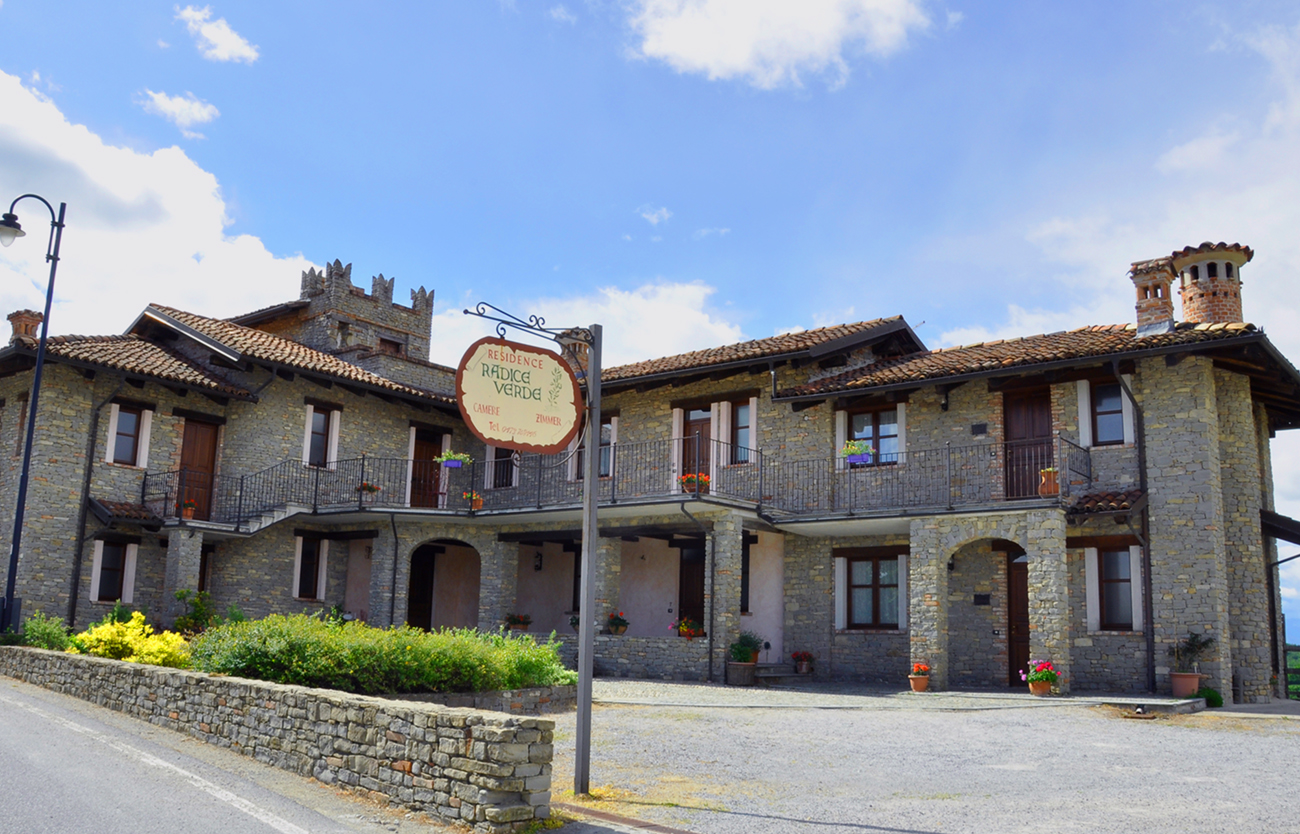
Agriturismo Balcone sulle Langhe Cissone
Agriturismo Balcone sulle Langhe - Cissone

Agriturismo Balcone sulle Langhe is located in a quiet location. Rustic rooms are comfortable, spacious and well-furnished. It's suggested the restaurant that offers traditional dishes with local products. Rooms have a balcony, fridge, kitchenette, air conditioned/heating, TV, telephone. 


Hotel Da Maurizio Cravanzana
Hotel Da Maurizio - Cravanzana

Albergo Da Maurizio is set in its spacious garden surrounded by the Langhe Hills and offers rooms decorated in a classic style with balcony. Some of these are fitted with tiled floors and some have parquet floors.The hotel restaurant is very good and very appreciated.  


Villa San Carlo Cortemilia
Villa San Carlo - Cortemilia

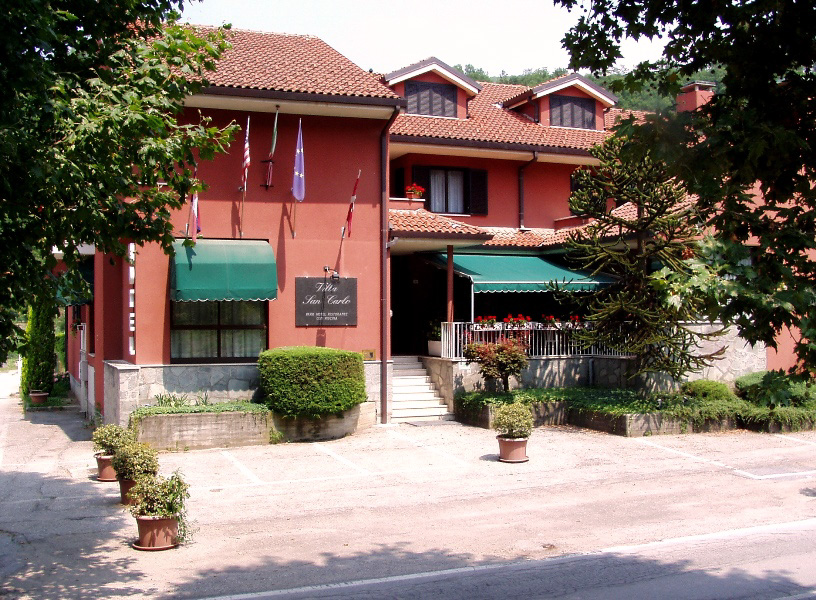
Family-run San Carlo is located in the hilly Langhe area and it's overlooking the surrounding woods. Rooms are comfortable, spacious and clean with satellite TV, a kettle and minibar. Free Wi-Fi is available in common areas. It's suggested the restaurant. Breakfast is good. 


When to travel


The Langhe area has a continental temperate climate; this climate is well suited for wine-cultivation. In fact, the feature of this climatic zone in Italy is a marked temperature range, high in summer often going up to 30°C and winter minimum temperatures that usually drop below freezing. Rainfall is not very abundant, more frequently in autum n and spring, with some big storm during the summerthat tends to be relatively dry. In winter the snow can make its appearance at low altitudes. There are frequent fogs and temperature inversions.The grapes used to produce top quality wines are even named after the common weather situation: moist and hazy, “nebbiolo”. The valleys are moist while the air above is clear, giving mysterious vista.

Is this for me?


This trip is perfect for walking in the beautiful Langhe and Barolo landscape, with the chance of tasting different wines every day of the week. Hotel rooms are comfortable, and the little villages are charming and quaint. The hikes are not too challenging and you can choose between longer or shorter options, making this trip suitable for all levels. 

What to bring


Clothing and other items
You will need your regular walking/cycling gear, including some sort of reflective garment. For the evenings, smart outdoor style trousers (or shorts) are invaluable, as are quick-dry t-shirts. These can be washed easily and will dry overnight and still look good for sightseeing or having a drink in town.

Take as little as possible to avoid potentially lugging a heavy suitcase up three flights of stairs at the end of the day. Please be aware that laundromats (“Laverie”) are not common in rural areas, so plan to do handwashing of small items.

Lightweight walking shoes/ trainers
For wearing around towns & villages. They can also be a back-up pair.

Socks & underwear
Take only good quality socks with quick-dry and insulating qualities. Road test them before you go on the trip. Take a suitable quantity of underwear as washing facilities are limited.

Warm jacket, hat, gloves
Bring a fleece, Polartec or warm layers for the evenings especially in spring or autumn; be sure it is totally suitable for your needs.
A fleece jacket which blocks the wind (Wind-stopper) is the most preferable. In the summer months a lightweight jacket is suitable for evenings.
If you are cycling/walking in mountainous or coastal areas, even in the height of summer, the weather can change very quickly and unexpectedly and you should be prepared for fog, mist, rain, snow or hail at any time. Always take an extra layer with you, as well as a warm hat and gloves.

Waterproof jacket & trousers
If you are caught in heavy rain, with good waterproof clothing you should remain dry. Remember that most garments will lose their properties over time. Few will remain waterproof for more than five years and many deteriorate in three years or less. We recommend a rain jacket with a good hood and collar and waterproof or thermal walking/cycling trousers or tights.

Dress code
In general, you should wear suitable clothing when entering a church (in many places, it is considered unacceptable to go inside wearing shorts or a tank-top). We suggest that women carry a shawl to cover up bear shoulders or low-cut tops. It also comes in handy when your shoulders get sunburned!

It is considered inappropriate for men to go without a shirt / T-shirt (other than at the beach).

Trekking poles (adjustable)
Highly recommended. A pair works best, depending on what you are comfortable with. If you suffer from back or knee pain this should be considered essential. Remember to practise walking with your pole(s) on different types of terrain in the months preceding your trip.

Walking boots
The importance of good footwear cannot be stressed enough. Your boots should be sturdy and of good enough quality to handle all types of terrain. Lightweight boots, (cordura/leather boots) which have Gore-Tex or sympatex water-proofing are most suitable for this trip. They should provide good ankle protection and be well broken in. Waxing leather boots regularly prolongs their life.

Walking tops & trousers
We recommend walking trousers and shorts and quick-dry wicking t-shirts. These can be washed easily and will dry overnight and still look good for sightseeing or having a drink in town. Wicking T-shirts are fast drying, keep moisture away from your skin and are available at outdoor stores. You should also bring one pair of loose-fitting trousers to wear in cities and for evenings out, etc. Shorts or zip-off trousers are useful in warmer weather.

Practical info

How to arrive


There are several daily trains from Turin to Alba and you need to change either in Asti or Cavallermaggiore. Timetables available on www.trenitalia.com. 

It is possible to book a transfer from Turin and Milan to Alba and vice versa.

On departure from Cortemilia, make your way to either Alba or Asti by bus and them reach the airports by train.

Mobile App


GUIBO is the app that allows you to easily follow your daily walking routes, with maps, tracks and useful information always available on your smartphone.

Practical information
With the download you will have access to three main sections:

  • Tour itinerary: the complete map of your trip with day-by-day routes.
  • Things to know: useful information such as emergency numbers, travel programme, accommodations and points of interest.
  • Service: technical support, FAQs and assistance if needed.

What to bring with you

To use the app at its best, we recommend having:

  • A fully charged smartphone or tablet (iPhone, iPad or Android)
  • The GUIBO travel app installed
  • The credentials to unlock your trip
  • A fully charged power bank

You may also like:

Hiking in the Chianti Hills

Location Italy
Duration 5 days
Walking
Level
Comfort Standard

Val Maira

Location Italy
Duration 8 days
Walking Dog friendly
Level
Comfort Standard
Wanderlust Nominee Best Specialist Tour Operator 2026
extraSmallDevice
smallDevice
mediumDevice
largeDevice
largeDevice
largeDevice