
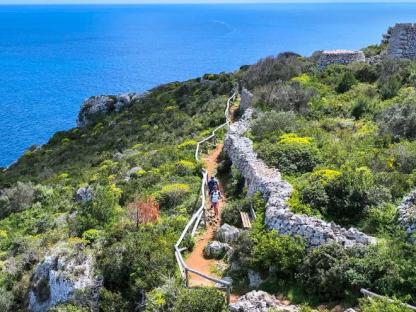
Hiker on a wild coastal trail overlooking cliffs and the deep blue Mediterranean during a day of hiking in Sardinia

Sardinia Coastal Walk

LEVEL
3
DISTANCE
85 km
DURATION
8 days | 7 nights
PERIOD
Apr May Jun Jul Sep Oct
PRICE FROM
€ 884
  1. Italy
  2.  | 
  3. Self-Guided
  4.  | 
  5. Tourcode ITSW340

When you arrive in the **Sulcis-Iglesiente region of Sardinia**, known as the **Costa Verde**, you instantly understand why it is such a remarkable place for hiking in Sardinia: remote, wild, and shaped by an ancient mining past that forged both its landscapes and its people. Eight thousand years of mineral extraction have left behind a unique blend of abandoned mining sites and pristine coastal beauty — a combination that sparks curiosity and that unmistakable feeling of “there’s a story to be told here”. In 2007, this vast mining area (about 3,800 km²) was declared a UNESCO Global Geopark. Step after step, as you walk southward, you begin to meet the soul of Sardinia: its warm, helpful and welcoming people, sometimes with that famous sardonic smile said to be inherited from centuries of resisting invaders.

The Sulcis region is also renowned among wine lovers for its Carignano grape, a hardy variety that survives with almost no water and grows low to the ground because of the relentless winds. Almost every family still produces its own Carignano del Sulcis — and one sip is enough to understand why.

Your journey ends on the island of Sant’Antioco, an evocative final stop. Here you’ll walk among stunning coastal views, ancient watchtowers and landscapes shaped by wind and sea.

read more >>

Highlights

  • Spectacular landscapes, a little-known part of Sardinia surrounded by wilderness and an ancient, magical atmosphere.
  • Great and varied walks: dunes and wildflowers, granite headlands with incredible views of the surrounding coastline and ancient watchtowers.
  • Beautiful beaches such as Piscinas, perfect for a dip in Sardinia's crystal clear waters.
  • Small family-run accommodations and plenty of opportunities to try local specialties and Carignano wine.

Itinerary

Day 1

Arrive in Buggerru

Arrive in Buggerru
Your trip starts in the small village of Buggerru, a village that was founded in 1864 as mine settlement. After check-in at the hotel, take your time to visit the small town, you can relax by the beach or you can visit the “Henry Tunnel” an old mining site, a labyrinth carved into the rock that opens onto sheer views of the sea and rocky coastline.

Day 2

From Buggerru to Portixeddu, 13 km

From Buggerru to Portixeddu, 13 km
Today a very nice coastal walk is awaiting you. From Buggerru you start climbing along a secondary asphalt road overlooking the superb coast and the long beach of Portixeddu (this uphill section can be avoided by organizing a private transfer). After 5km / 3 mi of gradual ascent the route starts its descent into the gorge towards the dunes and artificial pine forest planted to prevent the sand to cover the main street and only access to the town. Along the last section you will walk through some military fortresses of the second world war. After a scrumptious lunch in Portixeddu you can take the bus to go back to Buggerru.

Distance: 13 km

Elevation gain: +607/-617 m

Day 3

From Ingurtosu to Scivu, 14,5 km

From Ingurtosu to Scivu, 14,5 km

After breakfast, a transfer (about 30 minutes) will lead you to the nearly-abandoned village of Ingurtosu from where you will start your walk towards the ruins of the ancient “Laveria Brassey” mine site. At some point today you may feel close to Charles Darwin when he arrived at the Galapagos in the 1830s. The dunes of Piscinas are the most extended desert area in Europe. For about 6km there is just you, the sea, the sand and the wind! At the end of the day a short transfer will take you to the agriturismo where you are going to spend the next two nights.

Distance: 14,5 km

Elevation gain: +50/-280 m

Day 4

Capo Pecora loop walk, 15 km

Capo Pecora loop walk, 15 km
Today you are going back to the sea (Scivu beach) then you take a footpath inside the Mediterranean macchia, leading you to a stunning panoramic view point on Capo Pecora granite promontory. Don’t miss to take some unforgettable pictures of what it is a unmissable highlight of your trip! You will then proceed to walk on to reach the tiny village of Portixeddu, notorious among surfers for its famous beach of Portixeddu. A short transfer will drive you back to the agriturismo.

Distance: 15 km

Elevation gain: +431/-559 m

Day 5

From Portopaglia to Portoscuso, 14 km

From Portopaglia to Portoscuso, 14 km

Morning transfer (1 hour) to the tonnara of Porto Paglia, the starting point of today’s walk. Even if this is a marked footpath (red/white signs) it is on a very wild and remote coastline. You follow a sandy footpath with stunning views of the cliffs.

Distance: 14 km

Elevation gain: +379/-386 m

Day 6

Carloforte loop walk, 12 km

Carloforte loop walk, 12 km
Today you take the ferries to Carloforte where start a round walk, climbing on secondary asphalt road towards the north side of the Island, where at the end of May they start the so-called Mattanza, a system of nets that for about 45 days capture the tuna fish. Back in Carloforte take a ferries to Calasetta then a private transfer to Sant’Antioco.

Distance: 12 km

Elevation gain: +379/-379 m

Day 7

Sant’Antioco walk via Torre Cannai, 16,5 km

Sant’Antioco walk via Torre Cannai, 16,5 km
Today’s a private transfer takes you to Capo Sperone, then you walk back to S.Antioco, passing by the watchtower Torre Cannai and the beach of Maladroxia (popular spot when the maestrale wind blows). The last part to town is on asphalt road

Distance: 16,5 km

Elevation gain: +439/-381 m

Day 8

Arrivederci Sardegna!

Arrivederci Sardegna!
The trip and our services end after breakfast and depart for the airport with public transport unless you have pre-booked a private transfer with us.

Details

Included


What is included

  • 7 Nights in double room in **/*** hotels , B&B and agriturismi with breakfast
  • luggage transportation from hotel to hotel
  • transfers as described in the day by day program
  • maps and detailed description of the itinerary in digital form, app
  • Medical and luggage travel insurance
  • 24h phone assistance

What is not included 

  • Transfers to the starting location and from the arriving location of the tour
  • lunches and dinners, if not otherwise stated
  • visits and entrance fees - tips
  • personal expense
  • possible sojourn taxes
  • everything that is not mentioned in the "What is included" section.

Optional Services

These services can be added to the ones included in the base price of the tour:

  • Single room supplement
  • cancellation insurance
  • Transfers to reach the starting location or to leave the arriving location of the tour, which will be quoted on request.
  • travel documentation in printed form (maps and detailed description of the itinerary), shipped to the first hotel

Standard Hotels


Accommodation on Our Trips

Our adventures feature a variety of accommodations, depending on the location and the type of trip you choose. We carefully select each property, ensuring it is well situated along the route and locally run, so that you receive a warm welcome and enjoy a comfortable, authentic experience.

Your comfort is a priority throughout your travels. Most of our trips include stays in friendly, independent, or family-run hotels, guest houses, and B&Bs. Each accommodation is chosen for its charm, cleanliness, and those personal touches that make you feel at home. Some trips offer more elevated stays that feel like a special treat, while others may include simpler options, such as mountain refuges, particularly in remote areas.

Classic Hotels – Comfort with Character

Most of our trips combine a variety of accommodation styles to suit the route and location. You will typically stay in charming, locally owned B&Bs, guest houses, inns, and small hotels that offer a warm welcome and comfortable surroundings. These properties often feature extra touches such as distinctive regional character, leisure facilities, or renowned local cuisine.

All accommodations feature private ensuite bathrooms unless otherwise specifically noted for mountain huts, refuges, and pilgrim hostels.

On some mountain adventures and selected pilgrimage routes, the experience may also include more basic accommodation, such as mountain huts, refuges, or pilgrim hostels, where ensuite rooms are not always available and shared bathrooms or dormitory-style accommodation may be part of the experience.

While simpler in style, these accommodations are often rich in atmosphere and camaraderie, providing an authentic connection with fellow travellers and the places you visit.

Buggerru: Hotel La Rosa dei Venti


Agriturismo Majori

Majori is the ideal place forthose looking for a farm that follows the real passing of the seasons. A green tourism that puts the concepts of sustainability and quality of life at the center of its mission. An uncontaminated placesuitable for those who want to experience a stay of relaxation and tranquility, or organize excursions and trips by Mountain Bike or motorbike, or even for those who want to take a trip to discover the traditions and history of Sardinia.


Portoscuso: Hotel Don Pedro

The Don Pedro is a 3 star hotel located in front of the Portoscuso marina. Portoscuso is a small coastal town in South-Western Sardinia, in the Sulcis Iglesiente area. Connected to the Marina and only 100 meters from the small beach of Sa Caletta, the Don Pedro Hotel is the perfect starting point to discover Southern Sardinia.


Sant'Antioco: B&B Il Sentiero B&Bio

This B&B is near the sea in an area surrounded by peaceful countryside, in an area of great archaeological and architectural merit, in a quiet, panoramic setting, in the old city centre. "Il Sentiero B&Bio" has a hospitable and comfortable atmosphere.


When to travel


Sardinia has a typical Mediterranean climate with very hot long summers and short, mild winters. During summer, you can rarely experience somerainfalls,butweatherisquite stable from the middle of June until the middle of September.Inthis period the average daytime temperature near to the coast varies from 28°to 34° C, however, this can rise to 38°/40° Cwhenthe Scirocco wind blows from North Africa. Itis a verydry wind that makes the temperature feel slightly lower than it actually is. While the north-west main wind Mistral blows from the mainland of France.In the hilly and mountainous internal areas of the island, the daytime temperature may be similar to orslightly higher than the temperature in the coastal areas, whileat night the temperature in the internal areas is much lower than in the coastal oncewhich benefit from thesea breeze.

Is this for me?


A journey to discover the lesser-known Hiking in Sardinia, far from the Costa Smeralda and traditional tourist circuits - this part is wilder and less known, dominated by industrial and mining archaeology. The islands of Sant'Antioco and Carloforte are perfect for those who love the idea of island living. It's not a particularly challenging trip - the first day of walking is the most demanding, but it can be reduced with a transfer if necessary.

What to bring


Clothing and other items
You will need your regular walking/cycling gear, including some sort of reflective garment. For the evenings, smart outdoor style trousers (or shorts) are invaluable, as are quick-dry t-shirts. These can be washed easily and will dry overnight and still look good for sightseeing or having a drink in town.

Take as little as possible to avoid potentially lugging a heavy suitcase up three flights of stairs at the end of the day. Please be aware that laundromats (“Laverie”) are not common in rural areas, so plan to do handwashing of small items.

Lightweight walking shoes/ trainers
For wearing around towns & villages. They can also be a back-up pair.

Socks & underwear
Take only good quality socks with quick-dry and insulating qualities. Road test them before you go on the trip. Take a suitable quantity of underwear as washing facilities are limited.

Warm jacket, hat, gloves
Bring a fleece, Polartec or warm layers for the evenings especially in spring or autumn; be sure it is totally suitable for your needs.
A fleece jacket which blocks the wind (Wind-stopper) is the most preferable. In the summer months a lightweight jacket is suitable for evenings.
If you are cycling/walking in mountainous or coastal areas, even in the height of summer, the weather can change very quickly and unexpectedly and you should be prepared for fog, mist, rain, snow or hail at any time. Always take an extra layer with you, as well as a warm hat and gloves.

Waterproof jacket & trousers
If you are caught in heavy rain, with good waterproof clothing you should remain dry. Remember that most garments will lose their properties over time. Few will remain waterproof for more than five years and many deteriorate in three years or less. We recommend a rain jacket with a good hood and collar and waterproof or thermal walking/cycling trousers or tights.

Dress code
In general, you should wear suitable clothing when entering a church (in many places, it is considered unacceptable to go inside wearing shorts or a tank-top). We suggest that women carry a shawl to cover up bear shoulders or low-cut tops. It also comes in handy when your shoulders get sunburned!

It is considered inappropriate for men to go without a shirt / T-shirt (other than at the beach).

Power adapter & powerbank
If you are travelling from outside Europe, bring a power adapter suitable for European sockets (Type C/F). A powerbank is also highly recommended: keeping your smartphone charged throughout the day is essential for GPS navigation, and you will not always have access to a power socket during walking hours.

Trekking poles (adjustable)
Highly recommended. A pair works best, depending on what you are comfortable with. If you suffer from back or knee pain this should be considered essential. Remember to practise walking with your pole(s) on different types of terrain in the months preceding your trip.

Walking boots
The importance of good footwear cannot be stressed enough. Your boots should be sturdy and of good enough quality to handle all types of terrain. Lightweight boots, (cordura/leather boots) which have Gore-Tex or sympatex water-proofing are most suitable for this trip. They should provide good ankle protection and be well broken in. Waxing leather boots regularly prolongs their life.

Walking tops & trousers
We recommend walking trousers and shorts and quick-dry wicking t-shirts. These can be washed easily and will dry overnight and still look good for sightseeing or having a drink in town. Wicking T-shirts are fast drying, keep moisture away from your skin and are available at outdoor stores. You should also bring one pair of loose-fitting trousers to wear in cities and for evenings out, etc. Shorts or zip-off trousers are useful in warmer weather.

Practical info

How to arrive


Arrival in Buggeru

From Cagliari take the train to Iglesias  about 50-60 minutes ride (direct trains or with 1 change); from there you can take daily public busses to Buggerru via Fluminimaggiore (see www.arstspa.info). From Sant’Antioco, where the trip ends, you can take a bus to the city of Carbonia (see www.arstspa.info) and then a train from Carbonia to Cagliari Airport , about 1 hour ride (there are direct trains but 1 or 2 changes are possible, depending on trains)

Departure from Sant’Antioco

You can take a bus to Carbonia and then a train from Carbonia to Cagliari Airport 
 

Mobile App


Use the SloWays APP for iOS and Android smart phones in combination with the written documentation provided.

The App has the detailed tracks and maps that you can use offline and without roaming. Thanks to the phone’s internal GPS, you can check your exact position on the map, so you always know exactly where you are. It also helps you self-navigate you way while travelling. More information on how to use the App inside the roadbook documents.

The navigation features include:

  • Offline navigation. Mobile data not required after initial download
  • Accurate GPS tracks
  • Autorotation of the maps
  • Daily route summary and elevation chart
  • Panorama of the track and at street level
  • Alarm and vibration that alerts you in case you go off track.
  • Emergency SMS button with position coordinates
  • Possibility to record and take georeferenced photos of problems on route alerting fellow travelers
  • Hotel information
  • Points of interest along the way
  • Historical background

Sustainability


122 Kg/person

How much CO₂e does this trip generate?

Every trip leaves a footprint. Here you can find an estimate of the CO₂e emissions per person associated with this itinerary.

A practical way to better understand your trip's impact and make more conscious choices.

13 %

Transport

80 %

Accommodation

7 %

Activities

You may also like:

Frequently Asked Questions

Everything You Need to Know Before You Walk

Is this trip suitable for someone who has never done a multi-day coastal walk before?

Level 3 means this trip requires a reasonable base of fitness and some experience of walking on uneven, remote terrain. The daily distances range from 12 to 16.5 km, which is manageable, but the elevation gain on several days (up to +607 m on day 2) and the remoteness of the route mean you should be comfortable walking for 4 to 6 hours on rough paths without easy bail-out options. The most demanding day is day 2, and even that can be shortened with a private transfer on the steepest uphill section. If you are looking for an introduction to coastal walking in Sardinia, the Wild East Sardinia tour from Tiscali to Cala Gonone is a comparable option worth comparing.

The Sulcis-Iglesiente interior can reach 38-40°C in August, particularly when the Scirocco blows in from North Africa. On exposed coastal paths with no shade and limited water sources, those temperatures make walking genuinely uncomfortable and potentially unsafe. The best months are April, May, and June for wildflowers and mild temperatures, and September and October for warm seas and quieter trails. July is available but warm; if you travel then, plan early starts and carry extra water.

Most visitors to Sardinia head for the Costa Smeralda in the north. This route explores the opposite corner of the island: the Sulcis-Iglesiente, a UNESCO Global Geopark since 2007, shaped by 8,000 years of mining history. You walk through abandoned mine sites, across the largest dune desert in Europe at Piscinas, and finish on the island of Sant'Antioco, one of the oldest continuously inhabited places in the Mediterranean. It is a Sardinia most travelers never see. If you prefer the wilder, mountainous interior of the island, the Wild East Sardinia tour follows a completely different landscape from Tiscali to Cala Gonone.

Several days include short transfers that are part of the package, not extras. On day 3, a 30-minute transfer takes you to the nearly abandoned village of Ingurtosu. On day 4, a transfer returns you to the agriturismo after the Capo Pecora loop. On day 5, a one-hour morning transfer brings you to the tonnara of Porto Paglia. On day 6, you cross to Carloforte by public ferry, then take a private transfer to Sant'Antioco. All these transfers are included in the base price. The only transfers not included are your arrival in Buggerru and your departure from Sant'Antioco, both of which can be arranged on request.

Both are 8-day coastal walks in southern Italy, but the experience is quite different. The Salento Coastal Walk from Otranto to Lecce is level 2, flatter, and more cultural, passing Baroque towns and clear Adriatic waters. The Sardinia Coastal Walk is level 3, wilder, and more remote, with a strong industrial archaeology theme and fewer towns along the route. Salento suits walkers who want a sociable, accessible coastal experience; Sardinia suits those who want something rawer and more off the beaten track.

Wanderlust Nominee Best Specialist Tour Operator 2026
extraSmallDevice
smallDevice
mediumDevice
largeDevice
largeDevice
largeDevice